
A physical therapist in Dallas sees the same pattern every week: patients who sleep on their side half the night and their back the other half come in with neck stiffness that no stretch or adjustment fully resolves. The culprit is almost always their pillow — too high for back sleeping, too low for side sleeping, or the wrong firmness for both. Choosing the best pillow for side and back sleepers requires understanding a fundamental biomechanical conflict: side sleeping needs 4–6 inches of loft to bridge the shoulder-to-head gap, while back sleeping needs only 3–4 inches to maintain the cervical curve without pushing the chin toward the chest. A supportive pillow that serves both positions must either adjust its height dynamically or hit a precise middle ground that compromises neither position significantly.
Research from the Journal of Physical Therapy Science (2023) found that pillow height mismatch is the primary modifiable factor in sleep-related neck pain — more impactful than mattress firmness, sleep duration, or pillow material. For the estimated 60% of adults who alternate between side and back sleeping, this means pillow selection isn’t a comfort preference — it’s a health decision with measurable consequences. This guide provides the exact framework for choosing a best pillow for side and back sleepers that maintains proper cervical alignment in both positions without forcing you to choose one over the other.
Why Is Pillow Height So Critical for Side and Back Sleepers?
Pillow height (loft) determines whether your cervical spine maintains its natural curve or bends laterally (side sleeping) or flexes forward (back sleeping) — and incorrect alignment for even 3–4 hours causes morning stiffness, headaches, and cumulative disc stress.
Alignment requirements by position:
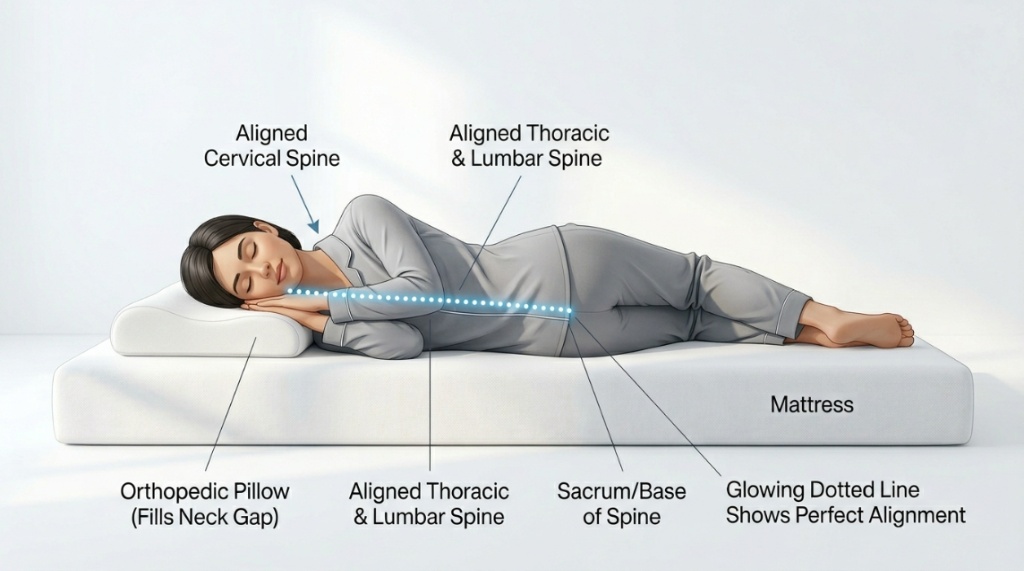
- Side sleeping alignment: Your ear, shoulder, and hip should form a straight horizontal line. The pillow fills the gap between your shoulder and head (typically 4–6 inches depending on shoulder width). Too low = neck bends downward. Too high = neck bends upward.
- Back sleeping alignment: Your ear should align with your shoulder when viewed from the side. The pillow supports the natural lordotic curve of the cervical spine (typically 3–4.5 inches). Too high = chin pushes toward chest (flexion). Too low = head falls back (extension).
The conflict: side sleeping needs 1.5–2 inches MORE loft than back sleeping for the same person. This is why single-height pillows always compromise one position.
What Pillow Types Work Best for Both Side and Back Sleeping?
Adjustable shredded foam pillows, contoured ergonomic pillows with dual-height zones, and responsive latex pillows that compress differently under varying pressure are the three pillow types that serve both positions effectively.
Type comparison:
| Pillow Type | Side Sleep Score | Back Sleep Score | How It Adapts | Price Range |
|---|---|---|---|---|
| Adjustable shredded foam | 9/10 | 8/10 | Fill redistributes under pressure; customizable height | $50–$120 |
| Contoured ergonomic | 8/10 | 9/10 | Higher edges for side, lower center for back | $60–$150 |
| Responsive Talalay latex | 8/10 | 8/10 | Compresses proportionally to pressure applied | $80–$180 |
| Down alternative (medium-firm) | 7/10 | 7/10 | Moldable but loses support over time | $30–$80 |
| Solid memory foam (medium) | 7/10 | 6/10 | Conforms slowly but fixed height | $40–$100 |
Best overall recommendation: an adjustable shredded foam pillow set to approximately 4.5 inches — slightly compressed for back sleeping (effective 3.5–4 inches under head weight) and fully lofted for side sleeping (4.5–5 inches with shoulder compression).
How Do You Find the Right Loft for Your Body?
Measure the distance from your ear to the outside of your shoulder while standing straight — this measurement equals your ideal side-sleeping loft. Subtract 1.5 inches for your ideal back-sleeping loft. Choose a pillow that hits the midpoint or adjusts between both.
Measurement method:
- Step 1: Stand against a wall with shoulders relaxed. Have someone measure from the wall to the side of your head (ear level). This is your shoulder-to-head distance.
- Step 2: Subtract your mattress compression (typically 0.5–1.5 inches depending on mattress softness). This gives your ideal side-sleeping loft.
- Step 3: Subtract 1.5–2 inches from your side-sleeping loft. This gives your ideal back-sleeping loft.
- Step 4: Choose a pillow that either adjusts between these two numbers OR sits at the midpoint.
Example: shoulder-to-head distance of 6 inches, minus 1 inch mattress compression = 5 inches ideal side loft. Minus 1.5 inches = 3.5 inches ideal back loft. Choose an adjustable pillow set to 4–4.5 inches, or a contoured pillow with 5-inch edges and 3.5-inch center.
What Firmness Level Works for Both Positions?
Medium-firm is the optimal firmness for side and back sleepers — firm enough to maintain loft during side sleeping without collapsing, yet soft enough to compress slightly during back sleeping for proper cervical support.
Firmness effects by position:
- Too soft: Collapses under side-sleeping pressure, dropping your head below neutral alignment. Feels comfortable initially but causes neck lateral flexion over hours.
- Too firm: Doesn’t compress enough during back sleeping, pushing your head into forward flexion. Creates pressure points against your ear during side sleeping.
- Medium-firm (ideal): Maintains 80% of its loft under side-sleeping pressure (adequate support) while compressing 20–30% under back-sleeping pressure (allows proper cervical curve).
The test: lie on your side on the pillow. If your head sinks more than 1 inch below the pillow’s surface, it’s too soft. Roll to your back. If your chin tilts toward your chest, it’s too firm or too high. Proper medium-firm feels supportive on your side and neutral on your back.
Finding the perfect balance of support and plushness is only half the battle; keeping that investment pristine is just as critical for long-term comfort and hygiene. Over time, sweat, oils, and allergens degrade the core materials that keep your spine aligned. If you want to maximize your new bedding’s lifespan, it helps to understand How Often Should You Wash Your Pillows? Expert Advice so you don’t accidentally ruin the loft. Interestingly, many luxury brands highlight these care routines when promoting the high-end, Celebrity-Endorsed Pillows that dominate modern bedding trends, proving that even the most elite sleep setups require proper upkeep to retain their shape.
How Do Contoured Pillows Help Side and Back Sleepers?
Contoured pillows solve the height conflict by design — featuring raised edges (4–6 inches) for side sleeping and a lower center channel (3–4 inches) for back sleeping, eliminating the need for manual adjustment or compromise.
Check Contoured pillow advantages:
- Built-in height differential: Higher lobes on each end support side sleeping; lower center cradles the head during back sleeping. No adjustment needed.
- Cervical support channel: The center depression follows the natural cervical curve, providing targeted neck support during back sleeping.
- Position-specific zones: Your head naturally finds the correct zone as you shift positions during sleep.
Contoured pillow limitations:
- Fixed dimensions — if the heights don’t match YOUR body, they can’t be adjusted
- Some sleepers find the shape restrictive or uncomfortable initially
- Not ideal for stomach sleeping (the raised edges interfere)
- Require specific pillowcase sizes that may not match standard bedding
What Materials Provide the Best Support Without Sacrificing Comfort?
Talalay latex and gel-infused memory foam provide the best balance of support (maintaining alignment) and comfort (pressure relief) for side and back sleepers — each with distinct feel characteristics.
Material comparison for dual-position sleepers:
- Talalay latex: Responsive, bouncy feel. Compresses proportionally to pressure — more pressure (side sleeping) = more compression, less pressure (back sleeping) = less compression. Naturally adapts to position changes. Breathable. Durable (5–8 years). Best for sleepers who move frequently.
- Gel-infused memory foam: Slow-response contouring. Molds precisely to head and neck shape in any position. Excellent pressure relief for side sleepers with ear/jaw sensitivity. Cooler than standard memory foam. Lasts 3–5 years. Best for sleepers who stay in each position longer.
- Shredded foam blend: Customizable firmness and loft. Individual pieces create micro-adjustments as you move. Good airflow between pieces. Lasts 3–5 years. Best for sleepers who want personalized height control.
- Down alternative (microfiber): Soft, moldable, lightweight. Can be bunched for side sleeping and flattened for back sleeping. Less consistent support than foam or latex. Lasts 1–3 years. Best for sleepers who prefer traditional pillow feel.
How Long Does It Take to Adjust to a New Supportive Pillow?
Most sleepers need 7–14 nights to fully adjust to a new supportive pillow — especially when transitioning from an unsupportive pillow that allowed poor alignment your muscles had adapted to.
Adjustment timeline:
- Nights 1–3: The pillow may feel “wrong” because your muscles are accustomed to compensating for poor alignment. Mild neck stiffness is normal as muscles release tension they’ve been holding.
- Nights 4–7: Muscles begin adapting to neutral alignment. Stiffness decreases. Sleep quality typically improves noticeably.
- Nights 7–14: Full adaptation. The pillow feels natural. Morning stiffness should be significantly reduced or eliminated compared to your previous pillow.
- Beyond 14 nights: If discomfort persists after 14 nights, the pillow height or firmness is likely wrong for your body — not an adjustment issue.
Important: don’t judge a supportive pillow after one night. The initial “different” feeling is not the same as “wrong.” Give your body the full adjustment period before deciding.
What Are the Best Pillows for Side and Back Sleepers Under $100?
The Coop Home Goods Original, Beckham Hotel Collection, and Sweetnight Adjustable Pillow offer excellent dual-position support under $100 with adjustable designs that accommodate both sleeping styles.
Top picks under $100:
- Coop Home Goods Original ($60–$80): Adjustable shredded memory foam + microfiber blend. Remove or add fill to find your perfect height. Machine washable cover. 100-night trial. Best overall under $100.
- Sweetnight Adjustable Pillow ($40–$55): Three removable layers let you customize height precisely. Gel-infused memory foam for cooling. Excellent budget option with genuine adjustability.
- Beckham Hotel Collection ($30–$50 for 2-pack): Down alternative with medium-firm density. Not adjustable but hits the 4–4.5 inch sweet spot that works for most side/back combination sleepers. Best value for non-adjustable option.
Conclusion
Choosing a pillow for side and back sleeping without sacrificing comfort requires solving the fundamental height conflict between these two positions. The solution is either an adjustable pillow set to a height that works adequately for both (4–4.5 inches for most adults), a contoured pillow with built-in height zones, or a responsive material like latex that naturally compresses differently based on position pressure. The wrong approach is accepting a single-height pillow that works perfectly for one position and poorly for the other.
Measure your shoulder-to-head distance, choose medium-firm support, and give any new pillow 7–14 nights of adjustment time before judging. The right supportive pillow eliminates morning neck stiffness, reduces headache frequency, and improves sleep quality measurably — making it one of the highest-return health investments you can make for under $100.
What’s your shoulder width and which position do you fall asleep in most often? Share in the comments — I’ll calculate your ideal pillow loft and recommend a specific model.
Frequently Asked Questions
What pillow height is best for side and back sleepers?
Most side and back sleepers need a pillow between 4–5 inches that compresses to 3–3.5 inches under back-sleeping pressure. The exact height depends on shoulder width — broader shoulders need higher loft for side sleeping. Adjustable pillows let you find the precise height for your body.
Is a firm or soft pillow better for combination sleepers?
Medium-firm is ideal. Firm enough to maintain loft during side sleeping (preventing head drop) but soft enough to compress slightly during back sleeping (allowing proper cervical curve). Avoid extremes — too soft collapses for side sleeping, too firm creates pressure points.
Can one pillow really work for both side and back sleeping?
Yes — adjustable shredded foam pillows and contoured ergonomic pillows are specifically designed for this. Shredded fill redistributes as you change positions. Contoured pillows have different heights built into different zones. Both solve the dual-position challenge effectively.
Why does my neck hurt when I switch from side to back sleeping?
Your pillow is likely too high for back sleeping. When you roll from side to back, the same loft that correctly filled your shoulder gap now pushes your head into forward flexion — straining neck muscles and compressing cervical discs. You need a lower loft for back sleeping or an adjustable pillow.
How do I know if my pillow is too high or too low?
Too high: chin tilts toward chest when on your back, or ear tilts toward ceiling when on your side. Too low: head tilts backward when on your back, or ear tilts toward mattress when on your side. Correct: ear aligns with shoulder in both positions, and neck feels neutral without muscle strain.
Should side and back sleepers use two different pillows?
Some sleep specialists recommend this approach — a higher pillow for side sleeping and a flatter pillow for back sleeping, switching as you change positions. However, most people find this impractical during sleep. An adjustable single pillow that works for both positions is more realistic for most sleepers.