

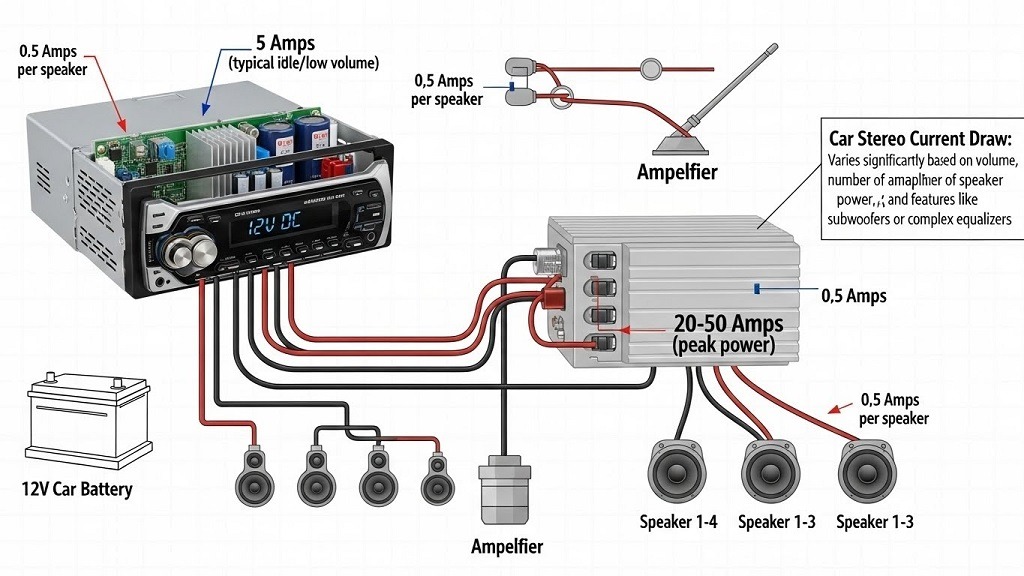
How many amps does a car stereo draw? In most daily‑driver cars, the factory head unit pulls roughly 2–10 amps at normal listening levels and may peak closer to 10–15 amps at higher volume, while full aftermarket systems with amplifiers can easily draw 40–150+ amps when cranked up. Understanding your car stereo amp draw helps you avoid dead batteries, prevent blown fuses, and plan upgrades safely.
What “amp draw” really means
Your car stereo’s amp draw is simply how much electrical current it pulls from the 12–14.4V system at a given moment. The more power your stereo and amplifiers produce, the more current they need from the battery and alternator.
Three key terms matter for this topic:
-
Voltage (V): Your car’s electrical system is about 12–14.4 volts.
-
Current (I, in amps): How much “flow” of electricity the stereo uses.
-
Power (P, in watts): The work done, such as driving speakers; given by P=V×I.
Once you know the watts your system uses and your system voltage, you can estimate amps with the basic car stereo watt to amp calculator formula I=PV.
Typical amp draw: stock vs upgraded stereos
Actual numbers vary, but real‑world measurements and manufacturer data give useful ranges for car radio power consumption.
Typical car stereo amp draw ranges:
-
Basic factory or low‑power head unit
-
Idle (on, low volume): around 0.3–1.5 amps.
-
Normal listening: roughly 2–5 amps.
-
Loud peaks: often 5–10 amps, sometimes up to 10–15 amps for feature‑rich units.
-
-
Aftermarket head unit with no external amp
-
Many single‑DIN/ double‑DIN units are rated roughly 15–25 watts RMS per channel into 4 speakers.
-
At 12–14.4V, that typically translates to somewhere in the 5–10 amp range at spirited volume.
-
-
System with external amplifiers
-
Small 200–300W total system: roughly 15–30 amps at full output.
-
Moderate 600–800W system: often 50–80 amps when pushed hard.
-
Big 1,000W+ bass‑heavy builds: 80–150+ amps at high volume, depending on efficiency and voltage.
-
For daily driving with the engine running, your alternator usually handles this without trouble, but long listening sessions with the engine off can drain a battery surprisingly fast.
Simple math: watts to amps for car stereos
You do not need a fancy car stereo watt to amp calculator to get close; the basic equation is enough: I=PV.
Step‑by‑step process:
-
Find or estimate the continuous (RMS) power of your stereo or amp in watts.
-
Add the watts for all channels or amps to get total system power.
-
Divide by system voltage (use 12V for conservative planning, 13.8–14.4V for “engine running” estimates).
Because real‑world amplifiers are not 100% efficient, multiply by a bit more (for example 1.2–1.4 for Class D, 1.5–1.7 for some Class AB designs) to get a realistic current draw estimate.
Real‑world examples of car stereo amp draw
Here are some simple, realistic scenarios that match what many drivers use.
-
Example 1: Stock head unit, four speakers
-
Assume about 4 × 15W RMS = 60W of audio power at loud but not insane volume.
-
At 13.8V: I≈6013.8≈4.3 amps, then add some overhead for inefficiency and features, giving around 5–7 amps.
-
This lines up with reports that many everyday head units draw in the 5–10 amp range at higher volume.
-
-
Example 2: Aftermarket head unit plus small 4‑channel amp
-
Say the external amp is 4 × 50W RMS = 200W total.
-
At 13.8V, ideal current is I≈20013.8≈14.5 amps.
-
Add efficiency losses and the head unit’s own consumption, and a realistic draw might be 18–25 amps at full tilt.
-
-
Example 3: 750W sub/door‑speaker system
-
Many enthusiasts run around 750W total on one or more amplifiers.
-
At 12.8V with the engine off, I≈75012.8≈58.6 amps in perfect conditions.
-
In real systems, tutorials show this kind of setup can pull around 130–140 amps when driven hard due to efficiency losses and dynamic peaks.
-
These examples show why knowing car stereo amp draw matters: as you add power, current demand rises quickly, and your wiring, fuses, and charging system must keep up.
What affects how many amps your stereo draws?
Several factors change your car radio power consumption from day to day.
Main drivers of amp draw:
-
Volume and music type: Louder listening and bass‑heavy tracks dramatically increase average current draw, especially into subwoofers.
-
Number of speakers and subs: More channels and bigger drivers require more watts and therefore more amps.
-
Amplifier class and efficiency: Class D amps are more efficient than many Class AB designs, so they deliver the same audio power with less current draw.
-
System voltage: Higher operating voltage (for example 14.4V vs 12V) lowers the amps needed for the same wattage, according to I=PV.
-
Built‑in features: Touchscreens, navigation, DSP, Bluetooth, CarPlay/Android Auto, and multi‑color lighting add a few extra watts.
Because of these variables, your stereo does not pull a fixed number of amps; it constantly changes with how you use it.
Engine on vs engine off
The same car stereo amp draw has very different consequences depending on whether the engine is running.
-
Engine running
-
The alternator supplies most of the power, typically handling 40–150+ amps easily on modern vehicles, depending on its rating.
-
As long as the total electrical load (stereo, lights, fans, etc.) stays within the alternator’s output, the battery remains charged.
-
-
Engine off
-
All power comes from the battery, which has limited capacity measured in amp‑hours.
-
A stereo drawing 5 amps for four hours uses about 20 amp‑hours, which is a big chunk of a typical starting battery and can leave you with a weak or dead battery.
-
Even small “always on” draws like memory and clock functions are normally just a few milliamps, but leaving a powerful system playing with the engine off can drain the battery quickly.
How to estimate your own car stereo amp draw
If you want to know how many amps your car stereo draws in your specific vehicle, you can get close with a few simple steps.
-
Step 1: Check equipment specs
-
Look up RMS wattage for your head unit and any external amplifiers in manuals or online product pages.
-
Note the number of channels and their power into your speaker impedance (usually 4 ohms for factory speakers).
-
-
Step 2: Add up total watts
-
Add all channels together: front, rear, and subs.
-
Use RMS numbers, not inflated “max” or “peak” ratings, for realistic car radio power consumption planning.
-
-
Step 3: Convert watts to amps
-
Use I≈PV, with V ≈ 13.8–14.4V when driving and 12–12.6V with the engine off.
-
Increase the result by 20–60% depending on amp efficiency and extra features such as displays and DSP.
-
-
Step 4: Validate with a meter (optional but best)
-
An inline DC clamp meter around the main power wire or a multimeter in series can show real‑world amp draw at different volumes.
-
Measure both “radio on, low volume” and “loud music” to see the range your car stereo actually uses.
-
This simple approach gives you a practical estimate without needing a dedicated car stereo watt to amp calculator app.
When do you need electrical upgrades?
As your car stereo amp draw climbs, you eventually reach a point where the stock wiring and charging system struggle.
Common signs you are near the limit:
-
Headlights dim or flicker with bass hits.
-
Voltage on a dash gauge or aftermarket voltmeter drops significantly when the music gets loud.
-
Amplifiers go into protect mode or shut off at high volume, especially on big bass notes.
Typical upgrade paths include heavier power and ground wiring, “Big 3” wiring upgrades under the hood, higher‑output alternators, and secondary batteries for extreme systems. Matching your wiring, fuses, and alternator rating to your estimated car stereo amp draw keeps the system safer and more reliable.
Practical tips for safe car stereo power use
To keep your system sounding good without killing your battery or equipment, follow a few simple best practices.
-
Use the right fuse sizes and quality wiring for the expected current, based on calculated amp draw plus a safety margin.
-
Avoid long, loud listening sessions with the engine off, especially if your system draws more than 10–15 amps at volume.
-
If you regularly use 600W+ of amplifier power, consider alternator and wiring upgrades so voltage stays stable under load.
-
Keep connections tight and corrosion‑free, because high current plus poor connections equals heat, voltage drop, and potential failures.
Planning your system around realistic current draw numbers is cheaper and easier than fixing electrical problems later.
FAQs: car stereo amp draw and power
Does a car stereo drain the battery?
Yes, any current draw will slowly drain the battery if the engine is off, and a stereo using several amps for hours can discharge a starting battery enough that the engine may not crank.
How many amps does a car stereo draw with the volume at zero?
With the radio on but very low volume, many units pull roughly 0.3–1.5 amps for their electronics, display, and internal amplifier idling.
How many amps does a car stereo draw at full volume?
A factory‑style head unit may draw 5–10+ amps at high volume, while systems with external amplifiers can need 40–150+ amps depending on total wattage and efficiency.
Is 10 amps enough for a car radio at home?
For a basic head unit on a 12V bench power supply, a 10A supply is usually adequate, but guides often suggest closer to 15A to handle loud peaks comfortably.
Do I need a bigger alternator for my stereo?
Many systems under 600W RMS work fine on a healthy stock alternator, but large 1,000W+ systems often benefit from a higher‑output alternator and upgraded wiring to avoid low voltage and dimming lights.
Call to action
If you are planning a new build or wondering “how many amps does a car stereo draw” in your own vehicle, take a few minutes to total your system’s watts and run the simple math so you know exactly what your electrical system must support. Use that estimate to choose the right wiring, fuses, and any alternator or battery upgrades—and if you are unsure, consult a reputable car audio installer to double‑check your numbers before you turn it up.
Related Topics: A Realistic Home Budget — Your Key To Smart House Hunting
Related Topics: These kitchen worktop materials will last a lifetime


